
SimpliSafe Base Station Offline After Update: 2026 Fix Guide
A firmware update is intended to make your home more secure, but for many SimpliSafe users, the process ends with a “Device Connection Problem” notification and a system that refuses to reconnect.
📝 Editorial Note: This guide is AI-assisted and game data evolves rapidly. Please cross-reference with in-game information. Updated: 2026-07-23.
Quick Answer: If your SimpliSafe Base Station is offline after an update, it likely failed the Wi-Fi handshake. Fix it by unplugging the unit, removing the bottom screw to pull one battery for 60 seconds, and restarting to force a reconnection.
What it means
Related: Wyze Cam v2 Stopped Detecting Video Only Sound: 2026 Fixes · Fix Eufy Security Integration: Home Assistant Core 2026.6.4 · Lorex NVR Credential Stuffing: 2026 Mitigation & Security Guide
When a SimpliSafe Base Station goes offline following a firmware update, the system’s primary communication hub has failed to re-initialize its network stack. In the SimpliSafe mobile app, this typically manifests as a “Device Connection Problem” or “Base Station Offline” error. While the system may still chime when doors open, it is effectively “blind” to the outside world, unable to send alerts to the monitoring center or receive commands from your smartphone.
In 2026, the Base Station (Gen 3, Model U9K-BS3000) uses its LED ring as the primary diagnostic tool. Understanding these light patterns is the first step in identifying whether your unit is simply disconnected or if the update has caused a deeper hardware “hang.”
2026 Base Station LED Status Codes
| LED Color | Pattern | Meaning in 2026 |
|---|---|---|
| Amber | Pulsing | Firmware update in progress; do not unplug. |
| Red | Solid | System error; update failed or hardware malfunction. |
| White | Pulsing | Searching for Wi-Fi credentials or “handshaking.” |
| Blue | Solid | System is armed and functioning normally. |
| No Light | Off | System is disarmed and functioning normally. |
Identifying a ‘Bricked’ vs. ‘Disconnected’ Unit
A “bricked” unit occurs when the firmware “flash” process is interrupted, leaving the Base Station without a functioning operating system. If the LED ring remains solid red for more than 30 minutes after an update attempt and does not respond to the Keypad, the unit may require replacement. However, if the Keypad displays “No Link to Dispatcher” but still allows you to navigate menus, the unit is likely just “disconnected” and can be recovered through a power cycle.
The 2026 ‘Trouble Signal’ Beep
Following the adoption of stricter UL-985 safety standards for residential fire and security systems, SimpliSafe firmware now includes an audible “Trouble Signal.” If an update fails to verify the system’s cellular or Wi-Fi path within a set window, the Base Station will emit a short, repetitive beep every minute to alert the homeowner that professional monitoring is inactive.
Why it exists
The SimpliSafe Gen 3 system relies on a specific sequence to apply updates safely. Because firmware files have grown significantly with the introduction of 2026 features like “Active Guard Outdoor Protection,” the stability of the local Wi-Fi network has become the single most common point of failure.
The Wi-Fi vs. Cellular Dependency
A common point of confusion is the role of the built-in cellular module. While SimpliSafe systems use cellular (typically LTE or 5G IoT bands) to send alarm signals to dispatch, they cannot download firmware updates via cellular. According to SimpliSafe’s official support documentation, a 2.4GHz Wi-Fi connection is mandatory for all system updates. If the Wi-Fi signal drops for even a few seconds during the “flashing” phase, the Base Station may lose its network configuration entirely.
Automatic vs. Manual Update Triggers
In 2026, SimpliSafe utilizes an automated update logic designed to minimize downtime. The process follows this flowchart:
- Disarm: The system must be in “Off” mode.
- Idle Period: The system must remain disarmed and inactive for at least 10 minutes.
- Download: The update is pulled via the 2.4GHz Wi-Fi band.
- Flash: The LED pulses amber as the code is written to the internal memory.
If a homeowner arms the system or a sensor is triggered during the “Flash” stage, the system may attempt to abort the update to prioritize security, occasionally leading to a “boot loop” where the Base Station fails to restart correctly.
How it works under the hood
To understand why an update fails, one must look at the dual-path communication architecture of the Gen 3 Base Station. The hardware utilizes a dedicated Wi-Fi chip for high-bandwidth data (video and firmware) and a separate cellular radio for low-bandwidth emergency signals.
The Bootloader Handshake
During a firmware update, the Base Station enters “bootloader mode.” In this state, the main security operating system is temporarily suspended. The bootloader’s sole job is to verify the digital signature of the new firmware package to ensure it hasn’t been tampered with. If the signature check fails—often due to a corrupted download caused by security camera Wi-Fi interference—the bootloader will refuse to “hand over” control back to the main OS, leaving the unit offline.
UL-985 Safety Standards and Firmware
Recent firmware versions (v2.21 and later) have been engineered to comply with UL-985 standards, which govern household fire warning system units. This requires the Base Station to perform a “self-health check” immediately after an update. If the unit detects that the Wi-Fi module is unresponsive post-update, it is programmed to trigger the red LED error state immediately rather than attempting to operate in a degraded mode.
Firmware Version Comparison (2026 Standards)
| Version | Release Era | Primary Stability Improvement |
|---|---|---|
| 2.15 | Late 2023 | Introduced background “silent” downloads. |
| 2.18 | 2024 | Improved 2.4GHz reconnection logic after router reboots. |
| 2.21 | 2025/2026 | Enhanced “Trouble Signal” logic and UL-985 compliance. |
| 2.25+ | 2026 | Support for Active Guard AI-driven outdoor threat detection. |
Real-world implications
An offline Base Station is more than a technical nuisance; it is a significant security gap. While the local sirens will still sound if a door is kicked in, the “handshake” with the professional monitoring center is broken.
Loss of Professional Monitoring
If your Base Station is offline, the “Fast Protect” or “Standard Monitoring” features are inactive. No signal will reach the monitoring center, and no emergency services will be dispatched. Furthermore, your 2026-era cameras, such as the Smart Alarm Indoor Camera or the Outdoor Camera Series 2, will stop recording to the cloud. These cameras use the Base Station as a bridge for authentication; without that bridge, they cannot verify your subscription status and will fail to upload footage.
The ‘Replace Base Station’ Protocol
If the hard reset (unplugging and removing batteries) fails to resolve the solid red light, the internal flash memory may have suffered a hardware failure. Under SimpliSafe’s 2026 warranty terms, systems under an active “Fast Protect” plan receive an extended lifetime warranty. Users on the “Self-Monitoring” or “Standard” plans are typically limited to the 1-year limited hardware warranty.
Decision Framework: Recover or Upgrade?
| If your situation is… | Prioritize this action: |
|---|---|
| Renter / Small Apartment | Perform the “Battery Pull” reset; signal interference is likely the cause. |
| Homeowner (Large Floorplan) | Move Base Station within 10 feet of the router during updates to ensure signal integrity. |
| Business / High Security | If the update fails twice, request a replacement unit; hardware reliability is paramount. |
| No-Wi-Fi User | Do not attempt updates; SimpliSafe Gen 3 requires Wi-Fi for all firmware maintenance. |
Common misconceptions
Misconception: Cellular backup will download the update if Wi-Fi fails.
Fact: This is the most common error. Cellular backup is strictly reserved for alarm signals and basic heartbeats. According to FCC ID U9K-BS3000 filings, the cellular module’s data throughput is optimized for reliability, not the large file transfers required for 2026 firmware packages.
Misconception: A red light always means an intruder.
Fact: While a red light during an alarm indicates a breach, a solid red light following an update typically indicates a “Kernel Panic” or a network initialization failure. Check your Keypad for the specific error message before assuming a security event.
Misconception: Resetting the Base Station deletes all your sensors.
Fact: A standard power cycle (removing the power cord and the NiMH backup batteries) does not wipe your sensor data. Sensor pairings and PIN codes are stored in non-volatile memory (EEPROM), which persists even without power. Only a “Master Reset” performed via the SimpliSafe technical support portal can wipe your sensor list.
Total Cost of Ownership (3-Year Outlook)
When considering the resilience of the SimpliSafe system, it is important to factor in the long-term costs of maintaining a connected system in 2026.
- Hardware Cost: Around $200–$400 for a standard starter kit.
- Subscription (Fast Protect): ~$30/month ($1,080 over 3 years). This includes the lifetime hardware warranty, which is critical if a firmware update bricks your unit.
- Subscription (Standard): ~$20/month ($720 over 3 years). Limited warranty.
- No Subscription: $0/month. No cloud recording, no professional dispatch, and a 1-year hardware warranty limit.
For users who prefer to avoid the “feature paywall” of cloud-dependent systems, exploring best no-subscription security cameras may be a more resilient long-term choice.
Frequently Asked Questions
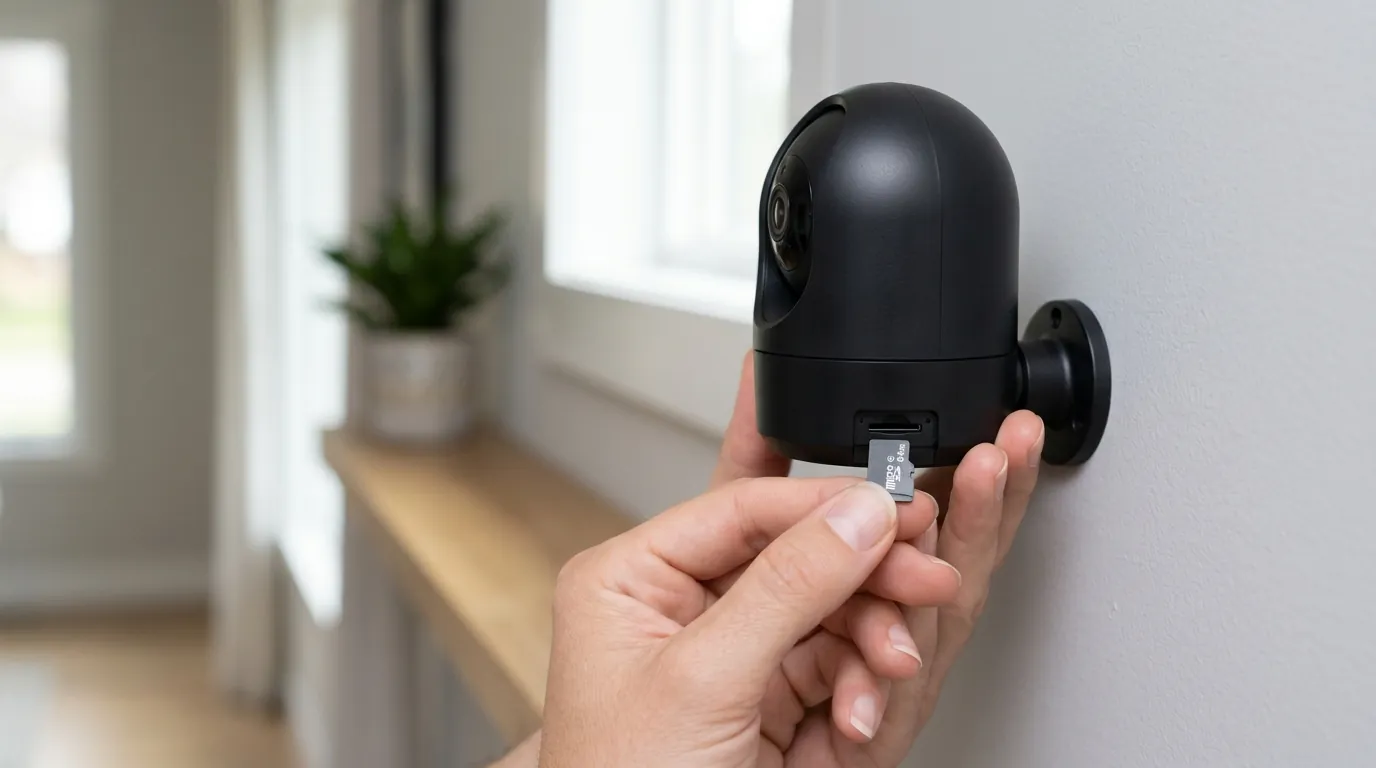
How do I perform a hard reset on a SimpliSafe Base Station?
To perform a hard reset, first unplug the power adapter from the wall. Use a Phillips head screwdriver to remove the single screw at the bottom of the Base Station and twist the cover off. Remove one of the four rechargeable batteries for at least 60 seconds, then reinsert the battery, replace the cover, and plug the unit back in.
Why is my Base Station pulsing amber for hours?
A pulsing amber light indicates an update is in progress. If this lasts more than 30 minutes, the download has likely stalled due to Wi-Fi interference. You should not unplug the unit during this phase; instead, try moving your Wi-Fi router closer to the Base Station if possible, or check your router settings to ensure the 2.4GHz band is active.
Can I skip SimpliSafe firmware updates?
While you can postpone updates via the Keypad, SimpliSafe occasionally pushes “Critical Security Patches” automatically. These are mandatory to maintain UL-985 compliance and ensure the system can communicate with the 2026 monitoring infrastructure.
Does SimpliSafe support 5GHz Wi-Fi for updates?
No. As of 2026, the SimpliSafe Base Station (Gen 3) only supports 2.4GHz Wi-Fi networks. If your router uses “Smart Connect” (merging 2.4GHz and 5GHz into one SSID), the Base Station may struggle to maintain a connection during the high-bandwidth firmware download phase.
Sources
- SimpliSafe Official Support: How to Update Firmware
- FCC ID Database: SimpliSafe Base Station BS3000 — https://fccid.io/U9K-BS3000
- SimpliSafe Terms of Sale and Warranty
- Reddit Community Troubleshooting: r/SimpliSafe Firmware Issues — https://www.reddit.com/r/simplisafe/
- UL Standards for Safety: UL-985 Household Fire Warning System Units — https://standardscatalog.ul.com/standards/en/standard_985_6