
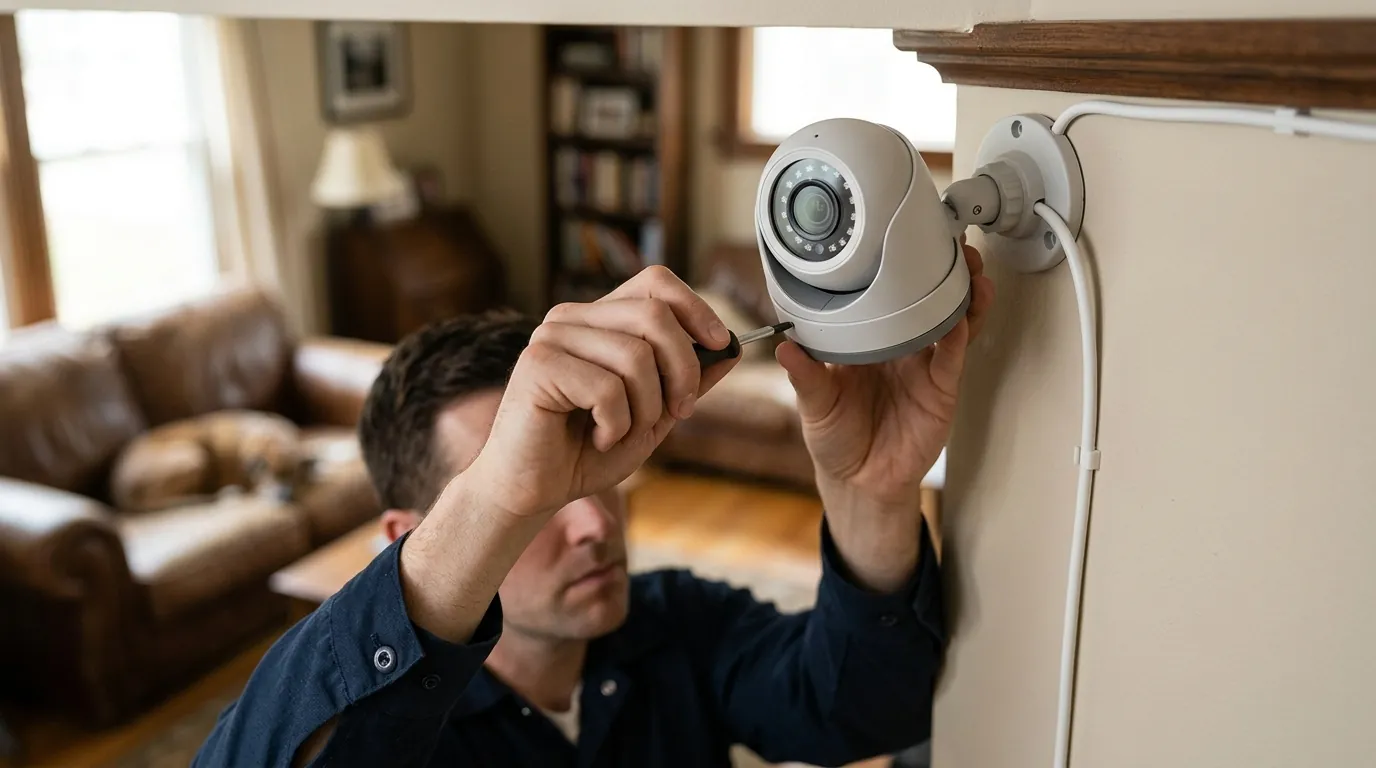
Best Indoor Security Camera for Pet Monitoring: 2026 News
As of mid-2026, the market for indoor pet monitoring has shifted decisively away from cloud-dependent subscriptions toward high-resolution “Edge AI” hardware that processes animal behavior locally.
For 2026, the Eufy Indoor Cam S350 and Reolink E1 Pro are top picks. They offer 4K/5MP clarity and local AI pet tracking without the monthly subscriptions required by Ring or Nest.
What happened
The first quarter of 2026 marked a pivotal transition in the indoor security camera industry, specifically for pet owners. The long-standing reliance on cloud servers for “smart alerts”—the ability for a camera to distinguish between a swaying curtain and a golden retriever—has been largely superseded by “Edge AI.” This shift means the processor inside the camera now handles complex behavioral analysis, reducing the need for expensive monthly “Pet Nanny” subscriptions.
The Rise of 4K Local-AI Pet Monitoring
Leading manufacturers have moved toward 4K resolution as the baseline for indoor monitoring. In early 2026, TP-Link Tapo expanded its lineup with the C260, a 4K pan-tilt model that introduced specialized AI algorithms capable of identifying specific pet activities, such as litter box usage or water bowl frequency, without transmitting that data to the cloud.
Simultaneously, Eufy released firmware version 3.3.2.6+ for the Indoor Cam S350. This update introduced the “Pet Diary” feature, which utilizes the dual-lens system to create automated daily highlight reels. By leveraging the HomeBase 3’s local processing power, the system identifies “key moments”—like a dog playing with a specific toy—and stitches them into a 60-second summary stored entirely on local hard drives. This move directly addresses the “subscription fatigue” reported by users who previously paid for similar features via Nest Aware or Ring Protect.
The Ring ‘Search Party’ Controversy and the Privacy Pivot
Privacy concerns reached a new peak in February 2026 following the launch of Ring’s “Search Party” AI feature. While marketed as a tool to help neighborhoods find lost pets by cross-referencing AI-tagged footage across multiple households, it sparked significant bipartisan backlash. Critics argued the feature effectively turned private indoor cameras into a neighborhood-wide surveillance net.
In response, a “Privacy Pivot” has occurred. Brands like Reolink and TP-Link have seen increased adoption by emphasizing physical privacy shutters and local-only data paths. The 2026 market now favors “Air-Gapped AI,” where the pet detection intelligence lives on the device, and the footage never leaves the owner’s local network unless explicitly requested.
2026 Local AI Features Comparison
| Feature | Eufy S350 (v3.3.2.6) | Reolink E1 Pro (2026) | Tapo C260 | Ring Indoor Cam (Gen 3) |
|---|---|---|---|---|
| Resolution | Dual-Lens 4K | 5MP (Super HD) | 4K | 1080p |
| Pet AI Type | Local (Edge) | Local (Edge) | Local (Edge) | Cloud-Based |
| Tracking | 360° + 8x Zoom | 355° Pan / 50° Tilt | 360° Pan / Tilt | Fixed |
| Specialized AI | Pet Diary / Tracking | Crying Detection | Litter Box Monitoring | Basic Motion |
| Storage | MicroSD / HomeBase 3 | MicroSD / Reolink Hub | MicroSD / Tapo Care | Cloud Only (mostly) |
| Subscription | Optional ($0 for AI) | Optional ($0 for AI) | Optional ($0 for AI) | Required for AI |
Why it matters for buyers
The shift in hardware and software capabilities has changed the “Total Cost of Ownership” (TCO) calculation for pet owners. In previous years, a cheap $30 camera often carried a $100-per-year hidden cost in the form of required subscriptions to access pet-specific alerts.
Eliminating the ‘Pet Nanny’ Tax
Subscription fatigue is driving US consumers toward brands like Reolink and Eufy. As of 2026, both Nest and Ring have raised their base subscription pricing for AI-filtered alerts. For a household with three cameras, the annual cost of cloud monitoring can now exceed the original purchase price of the hardware.
By choosing a camera with local AI processing, owners gain two significant advantages:
- Reduced Latency: Local AI allows for near-instantaneous two-way talk. When a camera detects a dog jumping on a kitchen counter, the notification reaches the owner’s phone in under a second, allowing for real-time correction. Cloud-based systems often suffer from a 3- to 5-second lag, by which time the behavior has already concluded.
- Legal Safety Nets: New 2026 state privacy laws in Indiana, Kentucky, and Rhode Island now classify indoor video as sensitive personal data. Small business owners (such as doggy daycares or grooming salons) using local-only storage are finding it easier to comply with these regulations, as they do not “share” or “process” data through third-party cloud providers.
The 4K Detail Advantage for Health Monitoring
Hardware specs have jumped significantly. In 2026, 4K is considered the standard for pet cameras because it enables “Digital Zoom with Clarity.” Pet owners are no longer just looking to see if their dog is awake; they are using cameras for health monitoring. High-resolution sensors allow users to zoom in on a pet’s collar tags to check if they are caught, or even monitor subtle health indicators like breathing rates or the presence of small surgical sutures during post-operative recovery.
Cost of Ownership: 3-Year Total (Estimated)
| Camera Model | Initial Hardware | Annual Subscription | 3-Year Total Cost |
|---|---|---|---|
| Ring Indoor Cam | Around $60 | Around $50 | Around $210 |
| Nest Cam (Indoor) | Around $100 | Around $80 | Around $340 |
| Eufy S350 | Around $130 | $0 | Around $130 |
| Reolink E1 Pro | Around $55 | $0 | Around $55 |
Note: Local storage models require a one-time purchase of a High-Endurance MicroSD card (around $20-40).
Impact on existing owners
The 2026 software updates have breathed new life into older hardware, while simultaneously highlighting the physical limitations of aging storage media.
Firmware Updates: Teaching Old Cameras New Tricks
Owners of the Eufy S350 and the older E220 models can now access the “Pet Diary” and improved tracking features via free firmware updates. However, these features are computationally heavy. Eufy’s documentation for v3.3.2.6 suggests that these AI features perform best when paired with HomeBase 3, which offloads the processing from the camera’s internal chipset to the hub’s more powerful AI engine.
Reolink E1 Pro users also received a significant software refresh in March 2026. The update improved “Pet Tracking” accuracy by 30%, specifically reducing “false positives” caused by robotic vacuum cleaners or shadows. Furthermore, a new “Crying Detection” algorithm was added, designed to alert owners if a pet is in distress or barking excessively, which is a vital feature for apartment dwellers concerned about noise complaints.
Storage Bottlenecks: Why Your Old SD Card Might Fail
The move to 4K and advanced AI has created a bottleneck for existing owners: storage speed. Legacy 1080p cameras functioned fine with standard Class 10 MicroSD cards. However, 2026’s 4K pet footage and simultaneous AI metadata tagging require “V30” or “U3” rated High-Endurance cards.
Owners using older, slower cards may experience:
- Stuttering Playback: The camera cannot write the 4K stream fast enough.
- AI Failures: The “Pet Diary” feature may fail to compile if the card’s read/write speeds are inconsistent.
- Card Burnout: Constant 24/7 recording at 4K resolution will wear out a standard SD card in months rather than years. Reolink’s support documentation now specifically recommends “High Endurance” cards for all 2026 4K models.
What to do now
For those shopping for a pet camera in 2026, the priority should be a balance of resolution, local intelligence, and physical privacy.
The 2026 Pet Camera Buying Guide
If you are currently in the market, we recommend the following three-tier approach based on your specific household needs:
-
For Multi-Pet Households: Eufy Indoor Cam S350 (Around $130-150) The S350 remains the benchmark for 2026 due to its dual-lens system. One lens provides a wide-angle view of the room, while the second telephoto lens provides an 8x hybrid zoom. This allows the AI to track a pet across a large living room without losing focus or detail. It is the best choice for those who want the “Pet Diary” experience without a subscription. Eufy’s product page details the HomeBase 3 integration for expanded storage.
-
For Privacy-Conscious Renters: TP-Link Tapo C225 (Around $50-70) For those who want a camera that “disappears” when they are home, the Tapo C225 is the top pick. It features a physical privacy shutter that rotates the lens into the housing when set to “Privacy Mode.” In 2026, this model remains popular for its reliable pet tracking and affordable entry point into the Tapo ecosystem.
-
For High-Detail Health Monitoring: TP-Link Tapo C260 (Around $100-120) If you need to monitor a sick or elderly pet, the 4K resolution of the C260 provides the necessary clarity. Its specialized AI for monitoring food and water intake is a standout feature for 2026, providing data-driven insights into a pet’s daily routine.
Privacy Checklist for Indoor Monitoring
Before deploying any indoor camera for pet monitoring, perform a “Privacy Audit” to ensure your data is secure according to 2026 standards:
- Audit App Permissions: Open your camera’s app and ensure “Remote Assistance” or “Cloud Sharing” is disabled. Some brands enable these by default to help “train” their AI, but this involves human reviewers potentially seeing your footage.
- Upgrade Storage: If you are buying a 4K camera, purchase a 256GB or 512GB “High Endurance” microSD card. This ensures you can store at least 7-10 days of continuous 4K footage locally.
- Enable Two-Factor Authentication (2FA): Regardless of the brand, ensure 2FA is active. With the rise of AI-driven hacking attempts in early 2026, password-only protection is no longer sufficient for indoor devices.
- Check Firmware: Ensure your device is on the latest version to receive the 2026 AI optimizations. For Eufy users, look for v3.3.2.6 or higher; for Reolink, check the March 2026 update log.
Decision Framework: Which Camera Fits Your Scenario?
- If you are a renter in a small apartment: Prioritize the Tapo C225. The physical privacy shutter is essential for small spaces where the camera is always in view, and the “around $60” price point is budget-friendly.
- If you have a large house with multiple pets: Prioritize the Eufy S350. The dual-lens tracking ensures you don’t lose sight of pets as they move between furniture, and the local AI avoids the high cost of multi-camera cloud subscriptions.
- If you are monitoring a pet with health issues: Prioritize the Tapo C260 or Reolink E1 Pro. The 4K/5MP resolution is necessary to see small movements or changes in behavior that 1080p cameras will blur.
- If you want a “Set it and Forget it” experience: Ensure you use a HomeBase 3 (Eufy) or Home Hub (Reolink). Centralized local storage is more reliable than individual SD cards and provides a single interface for all your AI alerts.
Quvii tracks these trade-offs across the category to help owners navigate the increasingly complex intersection of AI technology and home privacy.
Sources
- Eufy — Indoor Cam S350 Product Specs — https://www.eufy.com
- Reolink — E1 Pro 5MP PTZ Camera Support — https://reolink.com
- TP-Link Tapo — C260 4K AI Features — https://www.tp-link.com
- The Verge — Ring Privacy Controversy Report — https://www.theverge.com
- RTINGS — Security Camera Testing & Reviews — https://www.rtings.com
- FCC ID Search — Wireless Frequency Filings — https://www.fcc.gov/oet/ea/fccid
- PCMag — Best Pet Cameras of 2026 — https://www.pcmag.com
- TechGDPR — 2026 State Privacy Law Updates — https://techgdpr.com